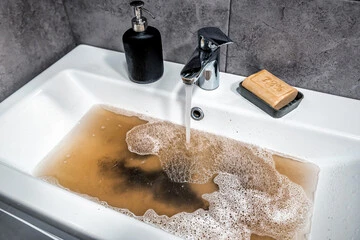
Why Drains Clog Faster in North Texas — The NTMWD Hard Water and Clay Soil Connection
DFW homeowners deal with recurring drain problems more often than they expect — and more often than homeowners in most other US metros face with comparable household habits. The cause is not what goes down the drain. It is what is happening inside the drain line and beneath the soil surrounding it. Two specific local conditions accelerate drain clog frequency in North Texas homes and understanding both changes how you approach the problem and what solution actually resolves it.
Why do drains clog faster in North Texas than in other regions?
Drains clog faster in North Texas because NTMWD and Dallas Water Utilities hard water deposits mineral scale on drain pipe interior walls continuously — narrowing the pipe and creating rough surfaces that catch grease and debris faster than smooth pipe. Dallas County, Collin County, and Rockwall County clay soil shifts drain lines off their original downward slope over time causing waste to accumulate at low points regardless of how recently the drain was cleaned. These two conditions operate simultaneously in most DFW homes and neither is present at the same combined intensity in most other US metros.
The Two Local Factors Behind DFW’s Higher Drain Clog Frequency
Most drain problems have a simple cause — something went down the drain that should not have. In DFW homes the problem is more complex. Two local conditions accelerate drain clog frequency independently and compound on each other when they operate in the same system simultaneously.
Factor 1 — NTMWD and Dallas Water Utilities hard water mineral scale
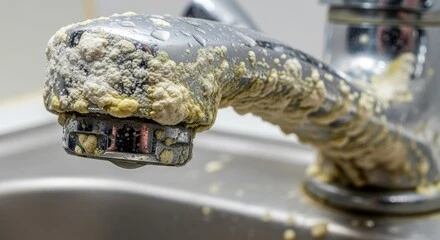
Every gallon of water that flows through a DFW drain line carries dissolved calcium and magnesium from the municipal supply. As that water contacts the interior drain pipe surface it leaves a microscopic mineral deposit behind. One pass leaves nothing measurable. Ten years of passes leaves a scale layer that has narrowed the pipe’s effective diameter, roughened its interior surface, and created a deposit-catching texture that accelerates every subsequent blockage. Unlike supply line scale which forms under pressure drain line scale forms during every water use event — every shower every dishwasher cycle every sink drain in the home.
Factor 2 — Dallas County clay soil movement shifting drain lines off grade
Residential drain lines depend entirely on gravity. A correctly installed drain line runs at a minimum downward slope of one quarter inch per foot toward the sewer connection. Dallas County, Collin County, and Rockwall County expansive clay soil swells when wet and contracts in dry heat. That seasonal movement shifts drain lines off their original installation grade over years and decades. A section running flat accumulates waste. A section running slightly uphill produces backflow. Both conditions cause recurring blockages that no amount of cleaning resolves permanently because the structural grade problem remains after every service call.
How the two factors compound is what makes DFW drain problems uniquely persistent. Scale narrows the pipe and roughens the interior surface. Grade loss slows flow velocity and allows waste to sit longer at low points. The combination produces blockages at a rate neither factor would generate independently. A drain line with both scale accumulation and grade loss in a Mesquite or Garland home is a system that will keep blocking regardless of how frequently it is snaked until both conditions are addressed.
Why these factors are unique to North Texas is the combination not the individual elements. Hard water exists in other US cities. Expansive clay soil exists in other regions. The specific combination of hard to very hard NTMWD and Dallas Water Utilities supply running through drain systems embedded in highly expansive Blackland Prairie clay soil — across tens of thousands of homes spanning multiple construction eras — is what makes DFW drain clog frequency higher than national averages consistently.
What causes drains to clog faster in DFW?
The two primary causes of accelerated drain clog frequency in DFW are hard water mineral scale from NTMWD and Dallas Water Utilities supply depositing on drain pipe interior walls and Dallas County clay soil movement shifting drain lines off their original downward grade. Scale narrows the pipe and catches debris faster. Grade loss slows flow and allows waste to accumulate at low points. Both conditions are active in most DFW homes simultaneously and compound on each other to produce blockage frequency higher than either cause would generate alone
How Hard Water Scale Builds Inside DFW Drain Lines
Hard water scale in drain lines works differently than scale in supply lines and most homeowners — and many plumbers outside the DFW market — do not fully account for the distinction when diagnosing recurring drain problems.
In supply lines scale forms under continuous water pressure. The pressurized flow carries dissolved minerals past pipe walls constantly and deposits accumulate at points where flow slows — valve seats fixture connections and directional bends. The scale is dense and adheres firmly to the pipe interior.
In drain lines scale forms during each water use event as drain water carries dissolved minerals from NTMWD and Dallas Water Utilities supply through the pipe. The difference is contact time. Drain water moves slowly by gravity rather than pressure. It contacts the pipe interior surface longer per gallon than pressurized supply water does. That extended contact time means more mineral deposition per gallon in drain lines than in supply lines under comparable water hardness conditions.
How scale narrows drain pipe interior diameter follows the same progression as supply line scale but with an additional consequence. As the scale layer thickens it does not remain smooth. It develops an irregular crystalline texture on its surface — rough and porous rather than the relatively smooth interior of an unscaled pipe. That textured surface changes how the drain line behaves fundamentally.
How scale creates surfaces that catch debris faster is the mechanism that most directly explains DFW’s elevated drain clog frequency. A smooth PVC or copper drain pipe surface allows grease, hair, food particles, and soap residue to pass through with normal flow velocity. A scale-roughened surface catches those same materials on its irregular texture. Each caught particle creates a slightly larger obstruction surface for the next particle. The accumulation accelerates geometrically — not linearly — as the scale surface grows rougher and the pipe diameter narrows simultaneously.
The compounding effect in a DFW drain line means that a homeowner with normal household drain habits — nothing unusual going down the drain — still experiences blockages faster than a homeowner in a low-hardness water region with identical habits. The difference is the pipe surface condition not the homeowner behavior. A newly cleaned drain line in a DFW home begins reaccumulating scale and catching debris from the first use after cleaning. The timeline to the next blockage is shorter than it would be in a scale-free pipe every single time.
Does hard water cause drain clogs in Texas?
Yes. Hard water from NTMWD and Dallas Water Utilities deposits mineral scale on the interior walls of drain pipes with every water use event. That scale narrows the pipe diameter and creates a rough irregular surface that catches grease, hair, and debris faster than smooth unscaled pipe. DFW homeowners with hard water experience drain clogs more frequently than homeowners in low-hardness water regions with identical household habits — the difference is the pipe surface condition not what goes down the drain.
How Clay Soil Movement Shifts Drain Lines Off Grade in North Texas
Grade loss from clay soil movement is the most misdiagnosed drain problem in DFW. Homeowners call for drain cleaning. The drain clears. It blocks again within weeks. Another cleaning. Same result. The cycle repeats because the cleaning addressed the symptom — the blockage — without addressing the cause — a drain line that no longer runs downhill.
How Dallas County, Collin County, and Rockwall County clay soil shifts seasonally follows a consistent annual cycle. Spring rainfall saturates the Blackland Prairie clay that underlies most of the DFW metro causing it to expand laterally and vertically. Summer heat pulls moisture from that same clay causing it to contract and pull away from embedded structures. That expansion and contraction cycle exerts upward, downward, and lateral force on every pipe embedded in or beneath it. Over 20 to 50 years of seasonal cycling those forces accumulate into measurable displacement of drain line grade.
How that shifting moves drain lines off their original slope is a gradual process that produces significant consequences over time. A drain line installed in 1972 at a precise quarter inch per foot downward grade may have sections today that run flat, sections that dip and rise, and sections that run slightly uphill — all from clay soil movement that operated continuously and invisibly for 53 years. The pipe itself may be structurally intact. The grade that made it function correctly is gone.
What happens when a drain line loses its grade is straightforward physics. Gravity no longer moves waste consistently through the pipe. At flat sections waste slows and deposits settle. At uphill sections waste cannot advance at all and accumulates behind the high point. Grease solidifies at low spots. Scale buildup accelerates at points where flow stalls. Root intrusion concentrates at joint failures that clay movement has opened. The result is a drain line that blocks repeatedly at the same locations regardless of how recently it was cleaned because waste is being deposited at structural low points that cleaning does not change.
How a line running flat or uphill produces recurring blockages despite cleaning is what distinguishes a structural drain problem from a maintenance drain problem. A structurally sound drain line cleaned by hydrojetting stays clear for months to years in normal conditions. A drain line with grade loss clears temporarily after cleaning and begins accumulating waste again at the same displaced low points immediately. The cleaning interval gets shorter over time as the grade loss progresses.
Why this problem is invisible without a camera inspection is the practical consequence that most affects DFW homeowners. There is no surface sign of drain line grade loss. No odor. No wet patch in the yard. No visible crack or collapse. The pipe looks intact from the cleanout opening. Only a camera run through the full sewer line reveals the grade profile — showing where the line runs flat where it dips and where it rises — and confirms whether the recurring blockage problem is a cleaning issue or a structural one.
Can clay soil cause drain clogs in North Texas?
Yes. Dallas County, Collin County, and Rockwall County expansive clay soil shifts drain lines off their original downward grade over decades of seasonal expansion and contraction. A drain line that loses its downward slope allows waste to accumulate at low points regardless of cleaning frequency. This structural grade loss is invisible without a camera inspection and produces recurring blockages that snaking and hydrojetting resolve temporarily but cannot fix permanently. It is one of the two primary causes of elevated drain clog frequency in DFW homes.
Which DFW Homes Face the Highest Drain Clog Frequency
Not every DFW home faces the same drain clog risk. Five factors determine where a specific property sits on the frequency spectrum — and most high-frequency drain problem homes share more than one of them.
Older homes with cast iron drain lines built before 1985 face the highest combined risk. Internal corrosion has been roughening the cast iron pipe interior for 40 to 70 years. Hard water scale has been depositing on that already-rough surface for the same period. Root intrusion has been entering through aging hub and spigot joints. And clay soil has been shifting the line off grade throughout. A pre-1985 DFW home with original cast iron drain lines that has never had a camera inspection is the highest-risk drain profile in the metro. Our cast iron sewer guide covers the full deterioration picture for these systems.
Homes built between 1978 and 1995 face a secondary drain problem beyond the polybutylene supply line issue those years are known for. The drain connections, cleanout fittings, and sewer transitions installed during this era are now 30 to 47 years old. Plastic fittings from this period used different formulations than modern equivalents and degrade at connection points under sustained hard water and clay soil stress. Joint failures at drain connections in this age range are increasingly common and produce both recurring blockages and slow developing leaks.
Homes with mature trees in Garland, Richardson, and Mesquite face elevated root intrusion risk. Established neighborhoods with 40 to 60 year old tree canopy have root systems that have been actively seeking moisture from aging drain line joints for decades. A single mature oak or elm within 20 feet of a drain line run produces root intrusion pressure that overwhelms aging joint seals in cast iron systems. These neighborhoods consistently produce the highest root-related blockage call volume in our service area.
Homes in areas with highest clay soil movement — lakefront properties near Lake Ray Hubbard in Rockwall and eastern Rowlett, and flood-prone low-lying neighborhoods — face accelerated grade loss from more frequent and more intense clay saturation cycles than inland properties on higher ground. More saturation means more expansion. More expansion means faster grade displacement over the same time period.
Homes that have never had a sewer camera inspection face elevated risk regardless of age because unknown condition is itself a risk factor. A drain line problem that has been developing for years without detection is further along its failure progression than one caught early. A single camera inspection establishes a baseline condition assessment that makes every subsequent drain decision — clean, repair, or replace — based on evidence rather than assumption.
Which DFW homes get the most drain clogs?
The DFW homes with the highest drain clog frequency are pre-1985 homes with cast iron drain lines, homes near mature trees in Garland, Richardson, and Mesquite where root intrusion through aging joints is active, and lakefront or flood-prone properties near Lake Ray Hubbard where clay soil movement is most pronounced. Homes built between 1978 and 1995 with aging drain connections and homes that have never had a sewer camera inspection also face above-average drain problem frequency.
Quick Summary — Drain Clog Risk Factors in DFW
- Pre-1985 homes with cast iron drain lines — highest combined risk
- Homes built 1978 to 1995 — aging drain connections at 30 to 47 years
- Mature tree canopy in Garland, Richardson, Mesquite — active root intrusion
- Lakefront and flood-prone properties — accelerated clay soil grade loss
- Homes with no sewer camera inspection history — unknown condition is a risk factor
- Hard water from NTMWD or Dallas Water Utilities — present in every DFW home
Why Snaking Is Not Always the Right Solution in DFW
Drain snaking is the most common response to a blocked drain in any market. In DFW it is frequently the wrong response — not because it fails to clear the blockage but because it clears only the blockage while leaving the conditions that produced it completely intact.
What a drain snake does is mechanical. A rotating cable is inserted into the drain line and advanced to the point of blockage. The cable head cuts through or pulls back the obstruction — a grease accumulation, a root mass, a debris buildup. The blockage clears. Water flows. The job appears complete.
What a drain snake does not do is equally important to understand. It does not remove the scale layer coating the pipe interior walls. It does not restore a drain line that has shifted off grade from clay soil movement. It does not seal a joint that roots entered through. It removes the visible obstruction while leaving the pipe surface, the grade profile, and any structural failures exactly as they were before the service call.
Why snaked drains in DFW re-clog faster than in low-hardness water regions is a direct consequence of leaving scale in place. In a smooth unscaled pipe a snaked drain stays clear for months to years in normal use. In a DFW drain line with scale-roughened interior walls the same normal household use begins depositing grease hair and debris on the rough scale surface from the first drain use after cleaning. The re-clog timeline shortens with every cleaning cycle that leaves the scale intact. A drain that re-clogs within two to four weeks of snaking in a DFW home is almost always a scale problem not a habit problem.
When snaking is appropriate in a North Texas home is a specific and limited scenario. A fresh organic clog — hair at a bathroom drain, grease accumulation that has not had time to harden into scale, food debris at a kitchen drain — in a pipe that camera inspection has confirmed is otherwise structurally sound with intact grade and no significant scale layer responds well to snaking. The obstruction is removed and the underlying pipe condition supports long-term flow without immediate reaccumulation.
When snaking is insufficient covers the majority of recurring drain problems in DFW homes. Scale buildup that has been accumulating for years requires hydrojetting to scour the pipe walls — a snake passes through it without removing it. Root intrusion that has re-entered through a failed joint clears temporarily with a snake and regrows through the same entry point within weeks. Grade loss from clay soil movement allows waste to accumulate at low points regardless of how cleanly the snake clears the line above those points.
Why does my drain keep clogging after snaking in a DFW home?
A drain that re-clogs shortly after snaking in a North Texas home almost always has one of three underlying conditions — hard water mineral scale coating the pipe interior that the snake passed through without removing, a drain line shifted off grade by Dallas County clay soil movement causing waste to accumulate at structural low points, or root intrusion through a failed joint that regrows after each clearing. Snaking removes the blockage but not the condition producing it. Hydro-jetting addresses scale. A camera inspection identifies grade loss and root intrusion.
When Hydro-jetting Is the Right Answer for a DFW Drain
Hydrojetting is not a premium version of drain snaking. It is a fundamentally different service that addresses what snaking cannot — the pipe wall condition rather than just the blockage at a single point.
What hydrojetting does that snaking cannot is scour the entire interior pipe wall surface along the treated run. A hydrojetting machine delivers water at 3,000 to 4,000 PSI through a specialized nozzle that sprays both forward and backward simultaneously. The forward spray clears the obstruction. The backward spray scours the pipe wall removing scale deposits root mass grease buildup and accumulated debris that has bonded to the pipe surface over years of hard water use. The result is not just a cleared blockage — it is a cleaned pipe interior that flows at closer to its original design capacity.
When hydrojetting makes sense in a DFW home covers three specific scenarios. First recurring drain clogs that re-appear within weeks of snaking — the pattern that indicates scale buildup is the underlying cause rather than an isolated organic blockage. Second cast iron drain lines in older Garland Mesquite and Richardson homes where decades of internal corrosion and hard water scale have combined to reduce pipe interior diameter significantly. Third pre-service preparation before trenchless sewer lining — a pipe interior must be thoroughly cleaned before a CIPP liner can be installed correctly and hydro-jetting is the standard preparation method.
When hydrojetting is not appropriate is equally important to understand before recommending it. A structurally compromised pipe — one with significant wall loss from corrosion collapsed sections or severely offset joints from clay soil movement — cannot withstand hydrojetting pressure without risk of further damage. Camera inspection before hydrojetting confirms whether the pipe structure can support the service. A licensed plumber who recommends hydrojetting without a prior camera assessment on a pre-1985 cast iron system is skipping a step that protects the homeowner from a more expensive problem.
Cost of hydrojetting in DFW runs $300 to $500 for a standard residential drain run compared to $150 to $250 for a standard snake service. The $150 to $250 premium over snaking delivers a result that lasts significantly longer in a hard water environment because the scale that drives re-clogging is removed rather than bypassed.
Why hydro-jetting lasts longer in DFW hard water areas than in low-hardness regions is a direct consequence of what it removes. In a low-hardness water region a snaked drain stays clear nearly as long as a hydrojettted drain because minimal scale is present to reaccumulate on. In a DFW home where scale has been building for years hydro-jetting removes that accumulated layer and resets the pipe interior to a condition that resists reaccumulation for significantly longer than snaking achieves. Our drain cleaning service includes both snaking and hydro-jetting with camera assessment to determine which method is appropriate for each specific drain condition.
Is hydrojetting worth it for a DFW drain?
Yes — for the right drain condition. Hydrojetting is worth the cost over standard snaking in DFW when a drain re-clogs repeatedly after snaking indicating scale buildup on pipe walls, when cast iron drain lines in older homes have years of combined corrosion and hard water scale accumulation, or when preparing a pipe for trenchless lining. It costs $300 to $500 versus $150 to $250 for snaking but removes the scale that drives re-clogging rather than simply clearing the current blockage. A camera inspection before service confirms whether the pipe structure supports hydrojetting pressure.
When a Camera Inspection Is the Next Step
When the same drain keeps blocking after professional cleaning — whether snaking or hydrojetting — the cleaning is no longer the right next step. The camera is.
When snaking and hydrojetting keep solving the same problem the pattern itself is the diagnostic signal. A drain that clears completely with hydrojetting and re-blocks within four to six weeks has a condition that hydrojetting cannot address permanently. That condition is almost always one of three things — a drain line running off grade from clay soil movement that allows waste to accumulate at the same structural low point after every cleaning, a joint failure that root intrusion re-enters through within weeks of being cleared, or a pipe wall deteriorated to the point where the rough corroded surface reaccumulates scale and debris faster than the interval between cleanings. None of these conditions are visible from the cleanout. All of them are visible on a camera image.
What a camera inspection reveals in a DFW drain system is the complete picture that symptom-based diagnosis cannot provide. Internal corrosion level — how much wall thickness remains and whether the pipe surface is actively flaking. Root intrusion — where roots have entered, through which joints, and how extensively they have grown inside the line. Scale accumulation level — how much mineral deposit remains after cleaning and how quickly the surface is likely to reaccumulate. Grade profile — where the line runs flat, where it dips, and where it rises from clay soil displacement. Pipe wall condition — whether any sections have collapsed or are at imminent collapse risk.
How camera findings determine the maintenance versus structural decision is the direct value of the inspection. A camera image showing moderate scale accumulation in a pipe with intact walls, intact grade, and no root intrusion confirms a maintenance problem — regular hydrojetting on a scheduled interval is the appropriate management. A camera image showing grade loss across 30 feet of the run, root intrusion through two joint failures, and wall thinning in the corroded sections confirms a structural problem — cleaning will not produce lasting results and repair or replacement is the appropriate response.
Camera inspection cost in DFW runs $150 to $350 for a standard residential main sewer line assessment. That cost is applied toward any repair or cleaning service that follows in most cases. It is the least expensive way to know with certainty whether a recurring drain problem is a maintenance issue or a structural one before committing to repeated cleaning costs that do not address the underlying condition.
What happens after camera inspection identifies a structural problem depends on what the camera shows. Localized root intrusion with intact pipe walls points to targeted spot repair or trenchless lining. Grade loss across a significant section points to pipe replacement or whole-run trenchless rehabilitation. Multiple compounding conditions — corrosion plus grade loss plus root intrusion — point to full sewer line replacement as the only cost-effective permanent solution. Our sewer line repair and replacement service and trenchless sewer repair service cover all post-inspection repair options with written estimates before any work begins.
How to Reduce Drain Clog Frequency in a DFW Home
Drain clog frequency in a North Texas home cannot be eliminated entirely — the hard water and clay soil conditions that drive it are outside a homeowner’s control. What can be controlled is how aggressively those conditions are managed and how much of the preventable accumulation reaches the point of a blockage.
Water softener installation is the highest-impact single change a DFW homeowner can make for long-term drain health. Removing dissolved calcium and magnesium before water enters the home’s pipe system stops mineral scale from depositing on drain pipe interior walls at the source. A drain line that receives softened water accumulates scale at a fraction of the rate of one receiving unsoftened NTMWD or Dallas Water Utilities supply. The drain health benefit compounds alongside the supply line and water heater benefits covered in our hard water guide for North Texas homeowners. A softener does not address existing scale already present in the drain system but it stops the continued accumulation that makes the next blockage inevitable.
Annual drain cleaning on older homes — particularly pre-1985 properties with cast iron drain lines — converts drain maintenance from reactive to proactive. A professional hydrojetting service performed annually on a scheduled basis removes accumulation before it reaches blockage threshold. The cost of one annual hydrojetting service at $300 to $500 is significantly less than the cost of an emergency drain call combined with the property disruption a complete blockage produces. For homes built after 2000 with PVC drain systems in good condition professional cleaning every two to three years is a reasonable maintenance interval.
Enzyme drain treatments are the only drain maintenance product safe for regular use in DFW homes with aging pipe systems. Enzyme-based treatments introduce beneficial bacteria that digest organic waste — grease, soap residue, food particles — on the pipe surface without the chemical reaction that damages pipe walls. Unlike chemical drain cleaners — lye-based or acid-based products — enzyme treatments do not generate heat, do not react with scale deposits in ways that accelerate pipe wall deterioration, and do not harm the beneficial bacteria in septic systems. Monthly enzyme treatment in kitchen and bathroom drains reduces organic accumulation between professional cleaning intervals.
What not to pour down DFW drains matters more in a hard water home than in a low-hardness water region because the scale-roughened pipe surface catches what would slide through a smooth pipe. Grease and cooking oils solidify on scale deposits faster than on smooth surfaces. Coffee grounds pack into scale texture and form dense plugs. Fibrous foods — celery, onion skins, artichoke leaves — wrap around root intrusion points and create blockages that resist snaking. In a DFW home with scale-coated drain lines these materials produce blockages that would not occur in a clean pipe.
Professional drain maintenance frequency by home age:
- Pre-1985 homes with cast iron drain lines — annual professional hydrojetting
- Homes built 1985 to 2000 — professional cleaning every one to two years
- Homes built 2000 to present — professional cleaning every two to three years
- Any home with a recurring blockage history — camera inspection followed by scheduled maintenance interval based on findings
How often should drains be cleaned professionally in North Texas?
In North Texas pre-1985 homes with cast iron drain lines annual professional hydrojetting is recommended due to combined hard water scale accumulation and internal corrosion. Homes built between 1985 and 2000 benefit from professional drain cleaning every one to two years. Homes built after 2000 with PVC drain systems in good condition typically need professional cleaning every two to three years. Any DFW home with a history of recurring drain blockages should have a camera inspection before establishing a cleaning interval — the camera finding determines the right frequency for that specific system.
What Does Drain Cleaning Cost in the DFW Metro
Standard drain snaking in the Dallas-Fort Worth metro runs $150 to $250 for a residential service call. Hydrojetting runs $300 to $500 depending on line length and blockage severity. A sewer camera inspection costs $150 to $350 and is applied toward any repair or cleaning service that follows. Camera inspection combined with hydrojetting in a single visit runs $400 to $700 — the most cost-effective approach for a recurring drain problem that has not responded to standard snaking.
Standard Snake Service — $150 to $250 Appropriate for a fresh organic clog in a structurally sound pipe. Includes cable insertion to the blockage point and mechanical clearing. Does not include pipe wall cleaning or structural assessment. Most cost-effective for an isolated first-time blockage with no recurring history.
Hydrojetting — $300 to $500 Appropriate for recurring clogs, scale buildup in hard water homes, and cast iron drain lines with combined corrosion and mineral accumulation. Includes high-pressure scouring of the pipe interior wall along the treated run. Cost varies based on line length, access point location, and severity of accumulation requiring removal.
Camera Inspection — $150 to $350 Applied toward repair or cleaning service in most cases. Provides a complete visual assessment of internal pipe condition — corrosion level, root intrusion, grade profile, and wall condition — before any repair or cleaning commitment is made. The most valuable single expenditure for a DFW home with a recurring drain problem history.
Camera Plus Hydrojetting Combined — $400 to $700 The recommended approach for any DFW home where a drain has blocked more than once in a 12-month period. Camera inspection confirms the pipe can support hydrojetting pressure and identifies any structural issues requiring repair before cleaning. Hydrojetting then scours the confirmed-intact pipe interior. Combined service cost is less than the two services booked separately in most cases.
What drives cost variation across all four service types is consistent. Pipe material affects hydrojetting pressure settings and time required — cast iron systems require different parameters than PVC. Access point location affects setup time — a cleanout accessible from the garage runs faster than one requiring toilet removal or exterior excavation. Blockage severity affects hydrojetting duration — a line with years of scale accumulation requires longer treatment than a recently cleaned line with a fresh organic blockage.
Use our plumbing cost estimator to get a realistic cost range for your specific home age, pipe material, and DFW city before calling anyone.
Recurring drain problems in a DFW home are not a reflection of how a homeowner maintains their property. They are the predictable result of hard NTMWD water depositing mineral scale on pipe walls and expansive clay soil shifting drain lines off grade — two conditions every North Texas home faces regardless of how carefully it is maintained. A licensed plumber with camera inspection equipment replaces the repeated temporary fix cycle with a single honest assessment of what is actually causing the problem and a written price to address it permanently.